How to Get More Demo Bookings From Your Website
Only 1–3% of B2B SaaS visitors book a demo. Here are five specific fixes to turn more of your paid traffic into booked, qualified demos.
Article written by
Niko Šneberger

How to Get More Demo Bookings From Your Website
Most B2B SaaS sites have the same leak. You pay for traffic, people land, a few of them are genuinely interested, and then almost all of them leave without you ever knowing who they were. Around 1–3% of visitors click "Book a demo". The other 97% or so are gone, and you're still paying for the ads that brought them.
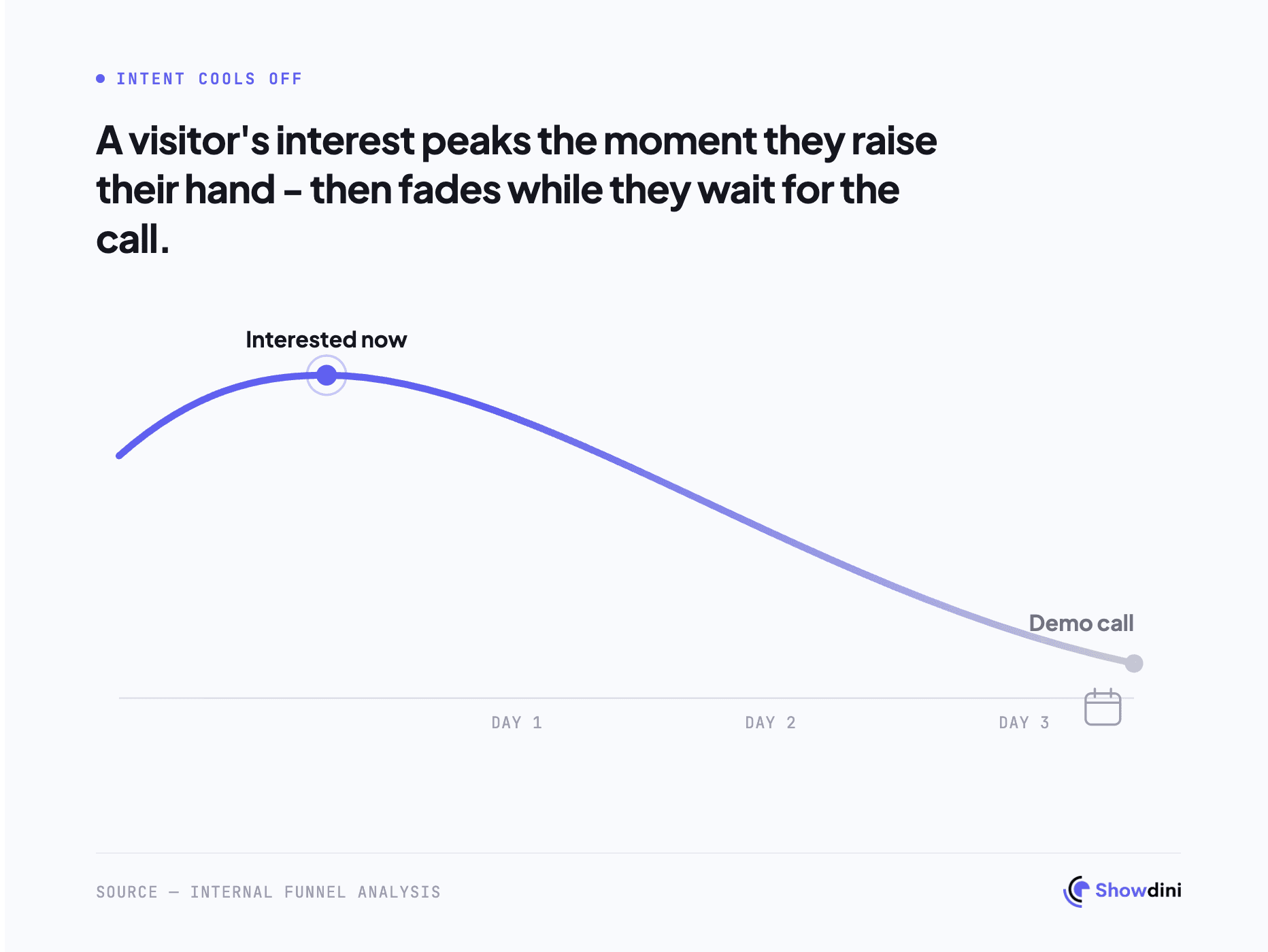
Then it gets worse. Of the people who do book, a large share never turn up. Demo show rates across B2B SaaS now sit around 55–65%, so roughly a third to nearly half of booked demos are no-shows. The reason is simple. "Book a demo" usually means "book a call three days from now", and interest doesn't keep for three days. People decide in the moment, and by the time the calendar invite comes round the moment has passed.
So the real question isn't "how do I get more clicks on the demo button". It's "how do I turn more of the interest I already pay for into a demo that actually happens". Below are five fixes, ordered roughly the way a visitor moves through your site. Each one is specific, and you can start on most of them this week.

The short version
More demo bookings come from four things: a landing page that makes the visitor feel understood, showing the product before you ask for a meeting, giving people an instant option instead of a three-day wait, and cutting the friction and delay out of the booking itself. Fix those and the same traffic converts several times harder.
Fix 1: Start with a landing page that actually speaks to the visitor
This is the backbone. Every other fix sits on top of the page, so if the page is generic none of the rest matters much.
The test is blunt. When your ideal customer lands, do they think "this is exactly my problem"? Or do they read three lines of vague product language and bounce? Most SaaS pages fail this because they lead with what the product is instead of what the visitor is stuck on.
A few things move the number here:
Match the message to the source. If someone clicks an ad about cutting demo no-shows, the headline they land on should say that, not your generic tagline. Mismatched message and page is one of the most common reasons paid traffic doesn't convert.
Lead with the problem, not the feature list. Write the headline about the visitor's situation and the outcome they want. Save the feature tour for lower down.
One clear action per page. A demo landing page with a full nav bar leaks people out to your careers page and your blog. Removing the nav from a focused landing page has been shown to lift conversion by roughly 15–25%.
Show proof early. Customer logos, a short result, a real quote. Around three quarters of high-converting demo pages put customer logos above the fold. If you have them, use them.
Cut the form down. Forms with more than four fields can drop conversion by 10–15%. Ask for what you need to route the lead and nothing else. You can enrich the rest later.
If your site lives in Framer, you can do most of this without a developer. If you want to spin up focused, use-case-specific pages faster, a tool like LandingRabbit turns your existing copy, decks and notes into publish-ready SaaS landing pages that actually converts. That matters because message match usually means more pages, one per campaign or audience, not one page doing all the work.
Fix 2: Let people see the product before you ask for a meeting
The gap between "this looks interesting" and "book a 30-minute call with a stranger" is bigger than most founders think. A visitor who is curious but not yet convinced won't jump straight to a sales call. They want to see whether the product is even the right shape for them first.
So show them. An interactive product tour or embedded demo lets a visitor click through the real interface and reach the "yes, this is for me" moment on their own, before any commitment. It fills the space between your landing page and your calendar.
What to do:
Add an interactive demo to your homepage and your main product pages, not buried on a single hidden page. Tools like Navattic, Storylane, Supademo and Arcade all do this.
Keep the tour short and pointed at one job the visitor cares about. A 20-step walkthrough of every feature loses people. Show the one thing that makes them think "oh, that's clever".
Put a booking option at the end of the tour, while intent is high, rather than making them hunt for it.
This won't convert everyone, and it isn't meant to. It qualifies interest cheaply so that the people who do reach out are warmer.
Fix 3: Offer an instant demo, with no commitment
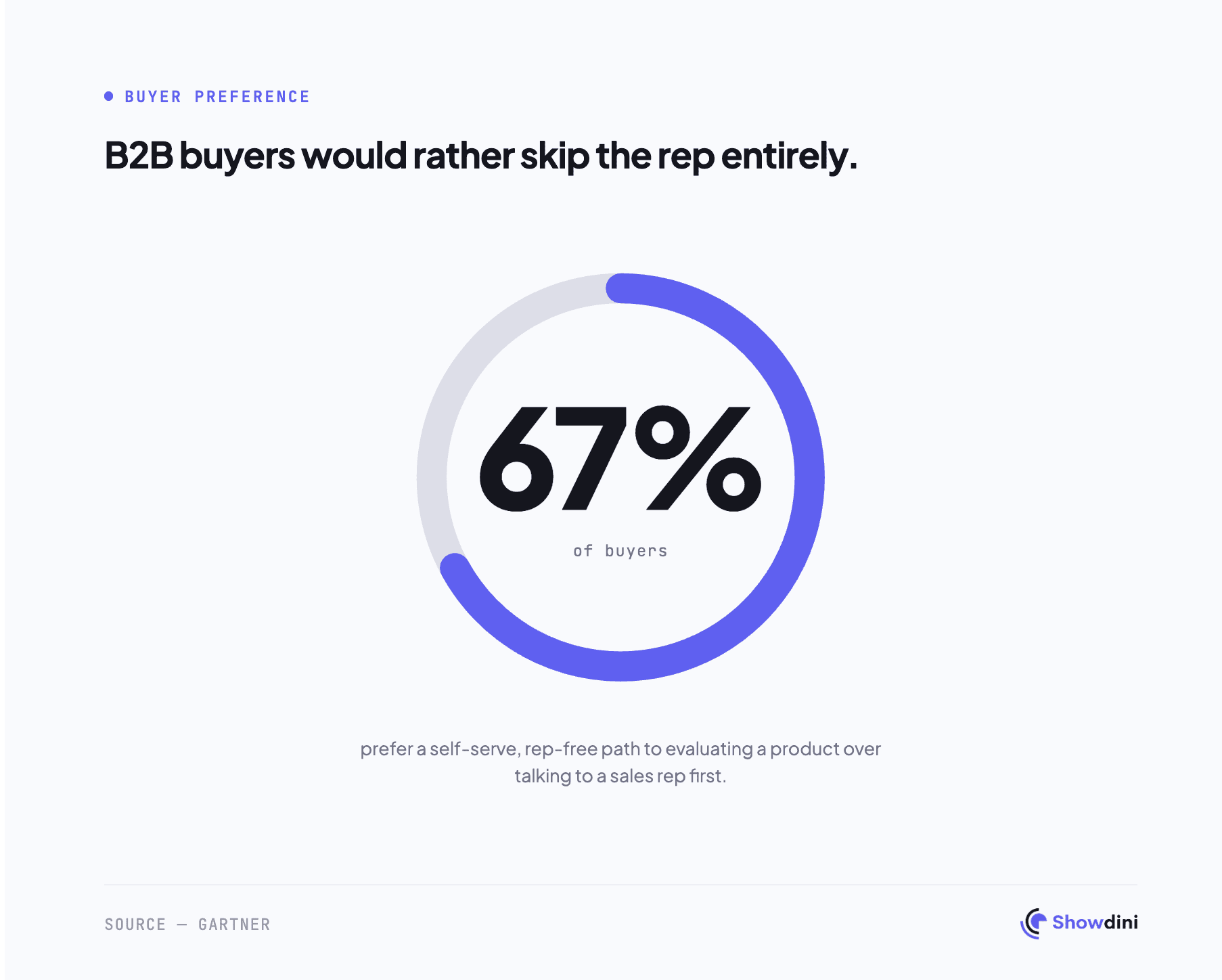
Here's the uncomfortable data. Gartner's 2026 sales survey found that 67% of B2B buyers prefer a rep-free buying experience, up from 61% a year earlier. Two thirds of your buyers would rather not talk to a salesperson at all, at least not yet.
"Book a demo" ignores that completely. It's the highest-commitment step on your site (a scheduled call, days out, with a human) offered to people who mostly don't want a scheduled call with a human. No wonder the button converts at 1–3% and half the bookings evaporate before the call.
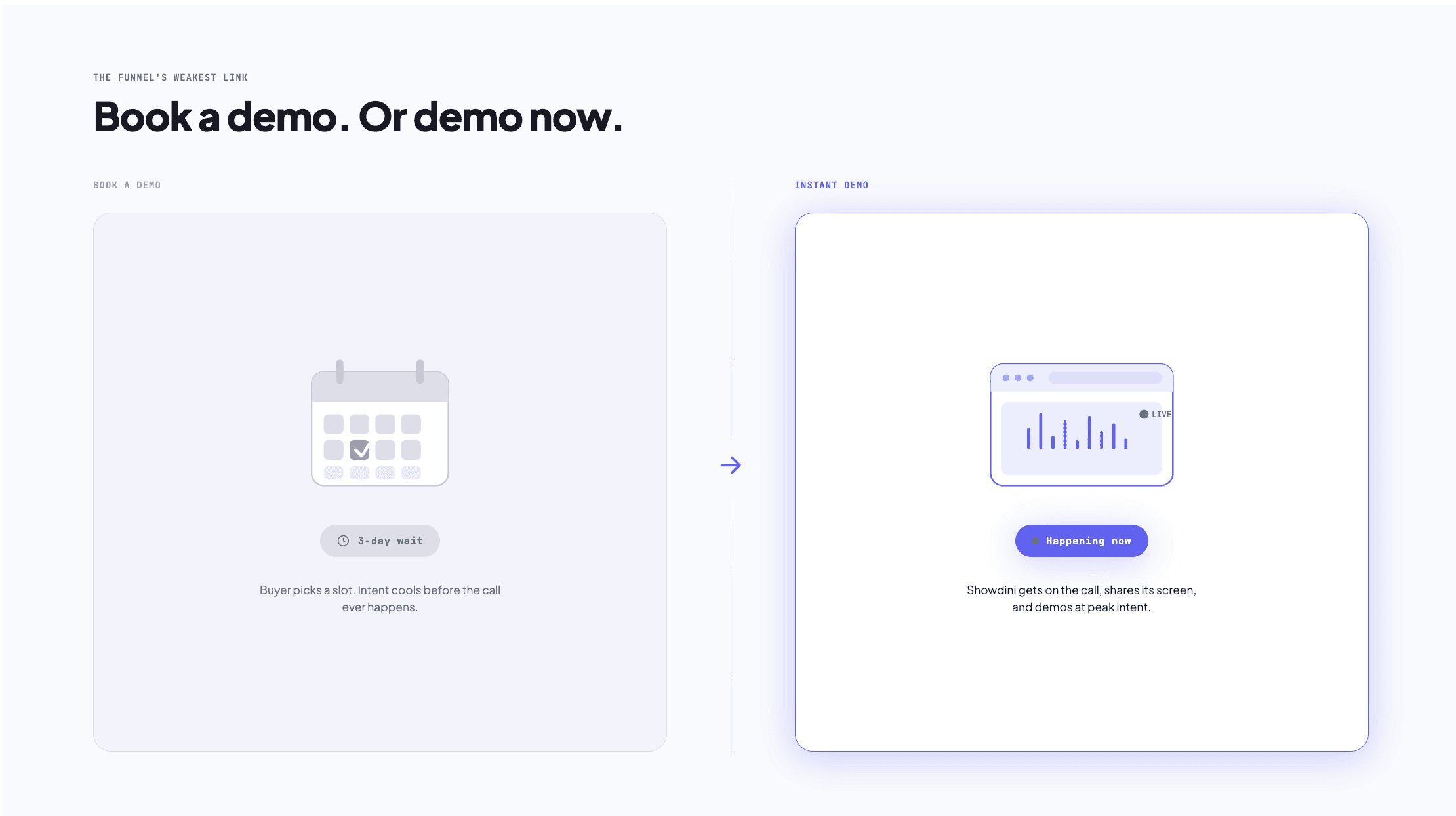
The fix is to give those buyers a real demo they can take right now, on their terms, with nothing to schedule. This is where Showdini fits. It's an AI sales rep that demos your product to a visitor the moment they're interested: it gets on a call, shares its screen, clicks through your actual product UI, and answers questions live over voice like a real rep would. Unlike interactive tools mentioned before, it tailors what it shows to what that visitor cares about, qualifies everyone it speaks to, and hands the qualified buyers to your sales team. No waiting, no scheduling, available at 2am on a Sunday.
Why it moves the number:
It removes the three-day gap entirely. The demo happens while intent is at its peak, so there's no window for interest to cool and no no-show, because there's nothing to not show up to.
It serves the 67% who'd rather not book a call, without losing them. They get the demo without the commitment, and you still get them qualified.
It's built to lift website-to-demo conversion from the typical ~3% up to 5–20%, and to hand sales warmer, pre-qualified buyers instead of cold form-fills.
To be clear about where this fits: an instant AI demo doesn't replace your human reps. It catches the majority who would otherwise leave without a trace, and lets your reps spend their time on the buyers who are actually worth a live call.
You can see how it compares to Arcade or Reprise here or experience Showdini demo in action.
Fix 4: Take the friction out of the booking itself
For the people who do want to book a call, don't make them wait for it. The classic flow (fill in a form, get a "we'll be in touch" email, receive a Calendly link the next day, book a slot for next week) adds delay at every step, and each step loses people.
Instant booking beats form-then-wait by a wide margin. Chili Piper's data on this is often cited: routing qualified leads to a calendar the instant they submit, rather than following up later, has been shown to roughly double conversion from booked meeting through to held meeting.
Practical changes:
Let qualified visitors pick a time on the page, right after they submit, instead of waiting for a link by email.
Qualify and book in one step so there's no back-and-forth to schedule.
Offer the soonest realistic slots. Same-day demos show up 78–88% of the time; demos booked 14 or more days out drop to 22–35%. The further out the slot, the more no-shows you're baking in.
Fix 5: Follow up in minutes, and cut no-shows on purpose
The last leak is between "booked" and "attended", and it's fixable with process rather than design.
Speed to lead is the big one. Responding within five minutes of a request, rather than hours later, dramatically increases the odds you actually connect. After a few hours, the lead has moved on or is talking to a competitor.
Then defend the booking you've got:
Send reminders. Booked demos with a sequence of reminders (24 hours, 1 hour, 15 minutes) show up around 68–78% of the time, against 38–48% with no reminders at all. Email plus SMS beats email alone.
Book close in. As above, the sooner the slot, the higher the show rate. If someone offers to meet in three weeks, try to pull it forward.
Chase no-shows fast. Immediate outreach after a missed demo recovers a meaningful share of them into a reschedule. A missed demo isn't a lost lead unless you treat it like one.
Putting it together
Rank these by where your leak is worst. If your paid traffic bounces without engaging, your landing page and message match (Fix 1) come first. If people engage but won't commit to a call, showing the product and offering an instant demo (Fixes 2 and 3) is where the gain is. If people book but don't turn up, the booking flow and no-show process (Fixes 4 and 5) are your problem.
The common thread across all five is speed and commitment. B2B buyers now expect information instantly and mostly don't want to be sold to. The sites that win the demo are the ones that meet interest in the moment it happens, instead of asking the visitor to wait three days for the privilege.
Frequently asked questions
What percentage of website visitors book a demo? For most B2B SaaS sites, roughly 1–3% of visitors request a demo. Top performers reach around 8–10%, usually by combining a sharp landing page with a lower-commitment option than a scheduled call.
Why do people book a demo and then not show up? Because the demo is scheduled days out and buying intent doesn't last that long. Show rates sit around 55–65%, and they fall the further out the slot is booked. Same-day demos show up far more often than ones booked two weeks ahead.
What's a good demo booking conversion rate? A visitor-to-demo rate of 2–5% is typical, and 8–10% is strong. The bigger lever is usually not the button itself but whether you offer an instant, low-commitment alternative to a scheduled call.
How do I reduce demo no-shows? Book slots as soon as possible, send reminders by email and SMS at 24 hours, 1 hour and 15 minutes, respond to requests within five minutes, and chase missed demos immediately. Better still, offer an instant demo so there's no gap for intent to cool in the first place.
Article written by
Niko Šneberger
Want to see Showdini AI agent demo in action?